Technical system profile
Metallic Arts
Three methods that use metals as focuses to push, store or transfer attributes. Their behaviour can be studied through the balance between energy input, conservation and loss.
- World of origin
- Scadrial
- Energy behaviour
- Input, conservation and loss regimes
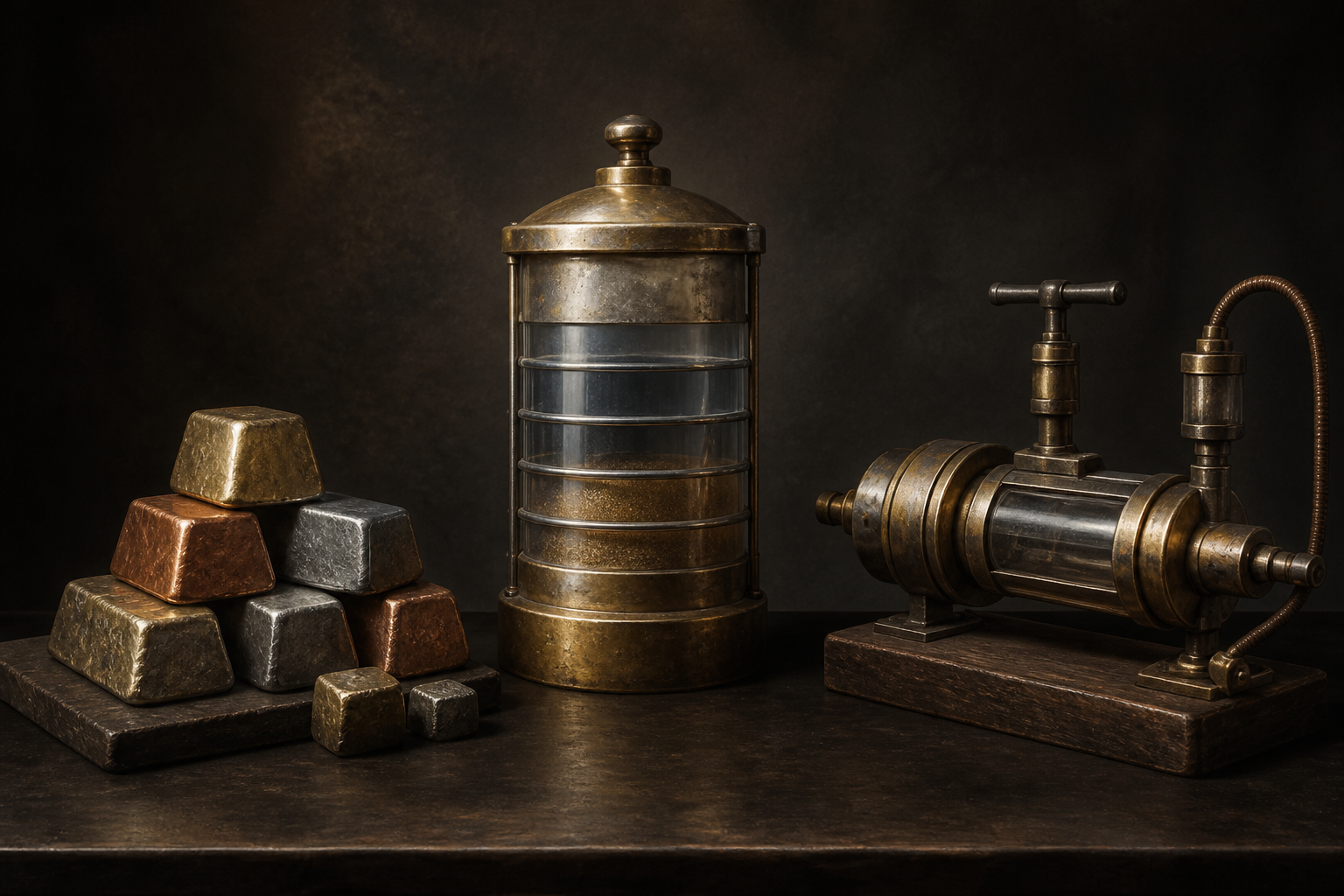
System overview
Metal is an interface, not fuel
The Metallic Arts do not consume metal to obtain its property. Each metal organises a specific interaction: it can trigger an effect, store a quantity for later recovery, or move an attribute between organisms.
Classification
Three architectures with different rules
Allomancy introduces energy while metal acts as a catalyst; Feruchemy conserves a property in metal and returns it later; Hemalurgy extracts a property from one individual and fixes it in another carrier, with loss during transfer.
Trade-offs and cost
Power, reserve and precision are exchanged
Capacity depends on available reserves, the correct metal and alloy, timing and the user's tolerance. Storing a property requires temporarily giving it up, while transferring it reduces the total result.
Known failures
Errors usually involve identification or dosage
An incorrect metal, contaminated alloy or insufficient reserve can produce a null or incomplete effect. Continued use can also distort perception and create dependence on a single attribute.